Tuesday, August 9, 2016

Cobh, Cork, Blarney Castle, Kinsale (Ireland)

Tuesday, August 9, 2016

Today the ship docked in Cobh, Ireland. This town has several claims to fame. They used to be a sending off port for those being deported to penal colonies such as Australia. This port was also the departure point for 2.5 million of the 6 million Irish people who emigrated to North America between 1848 and 1950. More famously, this was the spot where the Titanic picked up its final passengers. 123 passengers boarded here in all; only 44 of those survived the sinking. For those who are wondering why you don't recognize the name “Cobh,” that's because it used to be called Queenstown.
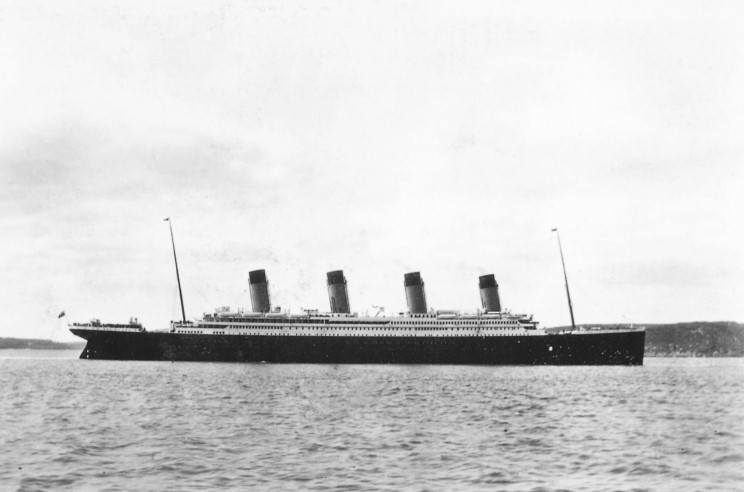

Imagecredit:http://www.maritimequest.com/liners/titanic/photos/ship/21_titanic.jpg

The ship offered a full day tour that we liked, but Frankie found the same tour with another company for $200 less, yeah.

First stop, Blarney Castle! The site dates back to before 1200, with a wooden house. It was replaced by a stone fortification but destroyed in 1446. In 1446, the third castle was built by Dermot McCarthy, King of Munster. In 1586, Queen Elizabeth I ordered The Earl of Leicester to take possession of the castle. The McCarthy clan always found ways to delay negotiations, for example throwing a banquet. Progress reports to the queen were long letters full of excuses, and the castle remained untaken.  In her irritation, the queen declared the reports to be full of “blarney”. 


Imagecredit:http://f.tqn.com/y/goireland/1/W/0/P/-/-/elizabeth-i-blarney.png

The castle has changed hands several times. In 2008, the present estate owner had to go to court to eject a man who had lived on the property for 44 years.


Imagecredit:http://media.irishcentral.com/images/swf+blarney+castle.jpg

The castle is now a partial ruin.  Of course, the most famous part of Blarney Castle is the Blarney Stone. Kissing it is supposed to bring eloquence. Here is the legend: The builder of Blarney Castle was facing a lawsuit, and asked the goddess Cliodhna for help. She told him to kiss the first stone he saw on his way to court. He did, and won his court case with great eloquence. So the owner added the stone as part of the parapet of his castle.


Imagecredit:https://underaglassmoondotorg.files.wordpress.com/2011/12/kiss-the-blarney-stone-coloring-page.jpg

Kissing the stone is not easy. First, you have to climb 127 steps to the top of the castle. Then the lineup. When it's your turn, you have to lay on your back and lean way out over empty space to kiss the stone. They have added railings for you to hold onto, and someone is paid to hold each tourist. Before the railings, they would just grab your boots and dangle you over. Sherlock Holmes solved a case of murder here, deeming the boots to have been greased.
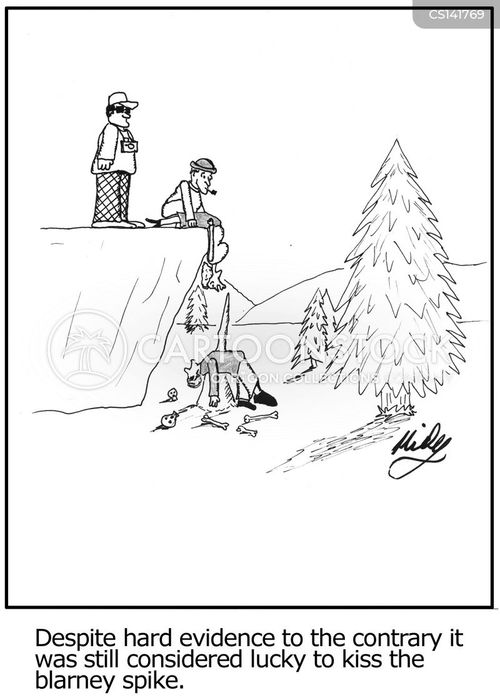


To kiss or not to kiss??? The question kind of answered itself when we got into line and found out it was a one hour wait. Since we only had 2 hours total, we decided we'd rather spend time exploring the rest of the extensive property.


We started with the Poison Garden which contains all poisonous plants (and cannabis). 


Then we found a really nice large rock garden area, with natural rock formations called Druid's Circle, Witch's Cave, and the Wishing Steps.


These are three of the Seven Sisters:


The trees all had knitted socks around them:


The bus was 15 minutes leaving Blarney.  Then when we were 10 minutes out, the guide told us that 2 people had been left behind and we had to go back to get them. Hello!?!? All kinds of stupidity there, first by people who can't catch a bus that is 15 minutes late, and secondly by a guide that doesn't know how many people he is responsible for.....  

After Blarney, we had a driving tour through the city of Cork. 

We looked out over the waters where the Lusitania was sunk on its 202nd sailing on May 7, 1915. The mighty passenger ship was running parallel to the south coast of Ireland and was roughly 13 km away from Kinsale, when it crossed paths with a German U-boat, who fired one torpedo. Because of the severe list of the ship, only 6 of the 48 lifeboats were launched successfully. The ship sank in 18 minutes, and 1,198 of the 1,962 passengers and crew lost their lives, most of whom were British or Canadian. Even though only 128 Americans were killed, the sinking of the Lusitania was instrumental in convincing the Americans to join the war.

 
Imagecredit:https://upload.wikimedia.org/wikipedia/commons/8/81/Bundesarchiv_DVM_10_Bild-23-61-17,_Untergang_der_%22Lusitania%22.jpg

The Germans felt that they had been justified in firing because the Lusitania was listed as an auxiliary war ship and was carrying ammunitions and military cargo. The German Embassy had even issued a warning before the ship sailed on this voyage. The British government has always maintained that there were no munitions on board. However, in 1982 they did warn divers (that were going down to the wreck) of a large amount of “ammunition” on board, some of which was “highly dangerous”.


Imagecredit:http://www.lusitania.net/lastrestingplace_htm_files/Lucy%202008%20-%20bullets.jpg
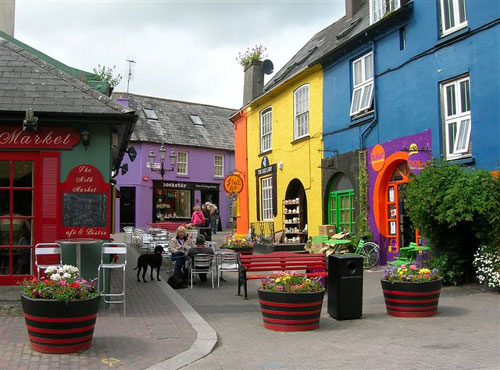
We were supposed to get 2 hours to explore the town of Kinsale, but ended up only having one hour there.  Kinsale was the town that was used for the rescue operation of the Lusitania, and some of the victims are buried here.


Chairmans Lane runs downhill towards the harbour and leads to the center of town. The lane has pretty cottages all attached to each other, with names such as Giants Cottage and MansionHouse.


St Multose Church dates back to 1190 and is the oldest building in Kinsale. It has a walled churchyard with ancient tombstones.


The final part of our tour was back in Cobh so we could be close to our ship. The Old Church Cemetery contains mass graves for the remains of 193 of the Lusitania victims.

 
Imagecredit:http://www.irishexaminer.com/remote/media.central.ie/media/images/z/zzzLusitaniaTommyBarkerP4A_large.jpg?width=648&s=ie-328221

We had a stop at St Colman's Catholic Cathedral.  It was begun in 1868 and took 47 years to complete. 


Here is the floor in the cathedral.  Very Irish:


Even though we were late going to supper back on the ship, we still got our window seat and still made it in time for the evening magician show.  He was a semi-fnalist on Spain's Got Talent.


History of Ireland


Celtic tribes (a group of people from the mainland of Europe) arrived on the island between 600-150 BC.  The name Ireland comes from the Irish word "Eire," which comes from the Celtic goddess named Eiru.

Image credit:  http://rs423.pbsrc.com/albums/pp316/cinn613/Goddess/Eiru.jpg~c200
The Celts would often raid the coast of Britain and bring prisoners back to Ireland.  On one such raid, they brought back a 16 year old boy named Patrick and put him to work as a shepherd.  During this time he took solace in God.  After 6 years, he escaped back home where he was ordained.  He felt the call to return to Ireland in 432 AD, and set about converting the pagans.  He used Irish symbols that the people could understand.  For example, he used the 3 leaf clover to illustrate the trinity of God.  Also, since the pagans worshipped the sun, he incorporated it into the celtic cross.  There is a legend that St Patrick drove all the snakes out of Ireland, and indeed Ireland has no snakes, but the evidence indicates that snakes never existed on Ireland (same as Iceland, Greenland, and New Zealand).  We celebrate St Patrick's Day on March 17th each year because that is the date he is supposed to have died, in 460AD.


Imagecredit:http://media.irishcentral.com/images/MI+Whats+behind+the+legend+of+St+Patrick+banishing+snakes+from+Ireland.jpg

Around 800 AD, Viking invaders began raids into Ireland and established settlements, including the capital of Dublin. There were many battles between the Vikings and Celts for 200 years, until a battle in 1014 defeated the Vikings. Peace was short lived, and Ireland was divided into many warring clans.


Imagecredit:http://irishclansnetwork.com/clans/wp-content/uploads/2012/05/genetic-heritage-ireland.jpg
In 1170, Ireland was invaded by Norman Vikings. The Norman Vikings were originally from Scandinavia, but were called Norman because the Viking chief Rollo had been granted land by the French king in the north of France. The Norman Vikings made Ireland an English territory under King Henry II of England.

Imagecredit:http://downloads.bbc.co.uk/rmhttp/schools/primaryhistory/images/vikings/what_happened_to_the_vikings/vk_bayeaux_sea.jpg
 By the 1600s, England's official religion became Protestant while most Irish remained Roman Catholic, creating tensions. In 1607, the Flight of the Earls occurred: leading families of Ulster (northern Ireland) refused to live under English dominance so they went to Spain for help but never returned. England kept control of Ireland by sending Protestant English farmers and landlords to replace the families that had left.


Imagecredit:https://blogger.googleusercontent.com/img/b/R29vZ2xl/AVvXsEjNk7crDqPiaqe4HLU_9UWdOH45FLRUhn2AkYjloY0cF64CiMmtt5PeLewv2X8gMHTcxgL5-agPGFl4t2HpOR2xAXdg8x-fCoQFM0CVXM_nSotFrdy-vGVAv5wsudxx5_rTfD-ISoFYcpnF/s1600/english_farmer.jpg

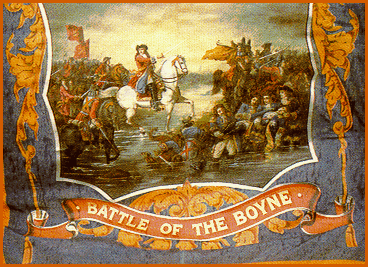
In July 1690, the Battle of the Boyne was fought in Ireland between Catholic James II and Protestant William of Orange. This was the last time that 2 crowned kings of England faced each other in battle. William of Orange won a crushing victory, which ensured Protestant rule in Ireland for many years.


Imagecredit:http://cbladey.com/boyne/Ban1.gif
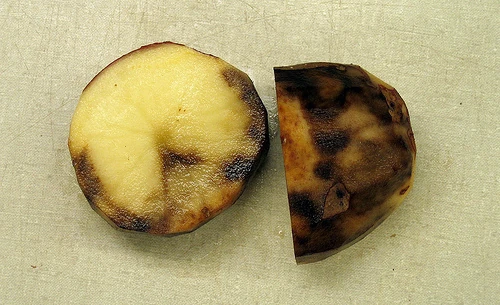
In 1692, new laws forbade Catholics to vote, own land, or practice their religion. The UK had also imposed Corn Laws which imposed steep import duties on foreign grain. These were a few of the factors that led to the Great Potato Famine between 1845 and 1852. At the time, almost half of the population faced poverty and depended heavily on their potato crops. Diseased potatoes were likely brought by ships from the eastern United States, and the blight spread quickly.
Image credit: http://vignette2.wikia.nocookie.net/gardener/images/d/db/Potato_Blight.jpg/revision/latest?cb=20100511182211
Ireland was hit harder than other places because they relied on only one or two varieties of potato. In the first year, between one third to one half the potato crops were affected. The following year, ¾ of the crops were lost. Meanwhile, the government continued to export grain, meat, and other foods to Britain. In Ireland, there was mass starvation, disease, and emigration.  

Many people were forced to live in Irish poorhouses, and by 1845 there were 123 of them.  Families in poorhouses were separated and forced into labour for long hours.  Conditions were so bad that the road to a poorhouse was called the "pathway of the dead" because more than a quarter of the people died there.


Imagecredit:http://www.abandonedireland.com/Workhouse_files/Workhouse.jpg
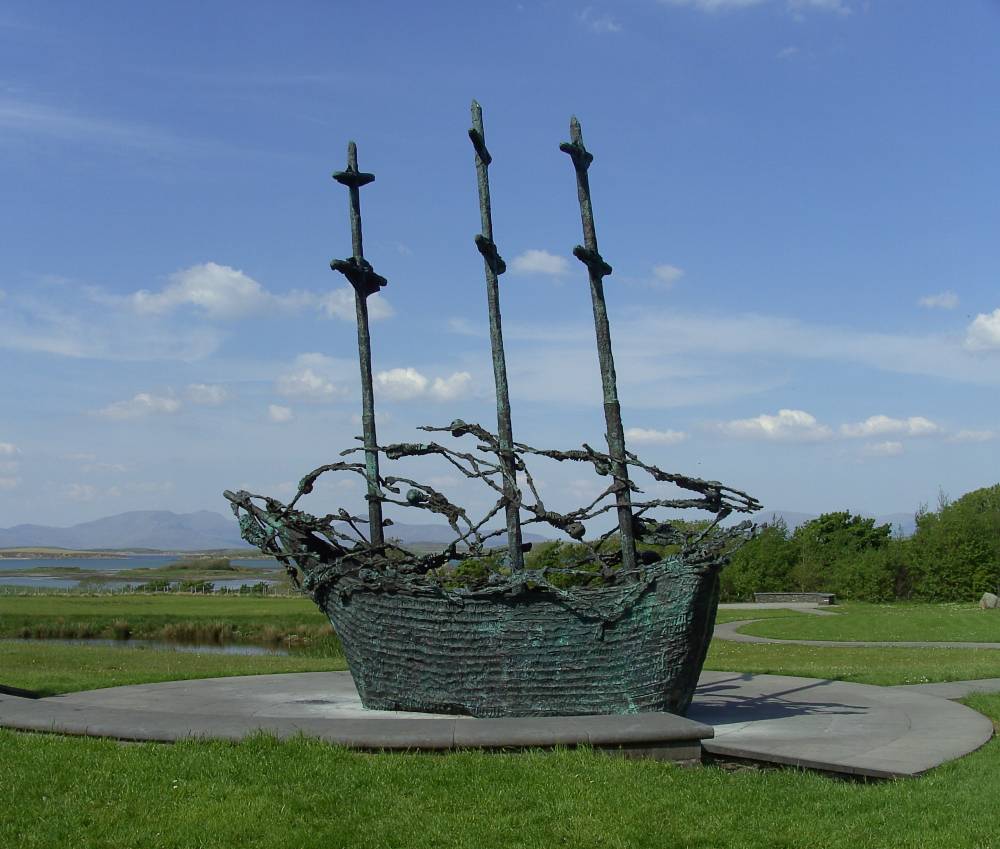
In all, about a million people died, and one to two million more emigrated.  Many of the ships that carried Irish immigrants across the Atlantic were called "coffin ships" because of the high mortality rate of the passengers (as high as 50%). Sharks were said to follow the ships because of the high number of bodies thrown overboard.  The ships were crowded, the passengers were given little food and water, and disease resulted.  This sculpture by John Behan commemorates the coffin ships, and is Ireland's largest bronze sculpture. It was unveiled in 1997 to mark the 150th anniversary of 
the potato famine:


https://www.google.ca/search?q=coffin+ships+ireland&newwindow=1&safe=off&espv=2&biw=1920&bih=955&source=lnms&tbm=isch&sa=X&ved=0ahUKEwiS7qv-3JrLAhUKkoMKHRTSCx0Q_AUIBigB#imgrc=5MglApSb-JCswM%3A

Meanwhile, a movement for Irish independence had begun, in large part due to the unfair laws against Catholics. The Easter Rebellion occurred in 1916, when armed Irish patriots rebelled against British troops in Dublin. The rebel leaders surrendered, and were jailed and executed by the British.


Imagecredit:http://www.irishtimes.com/polopoly_fs/1.2353912.1442411783!/image/image.jpg_gen/derivatives/box_620_330/image.jpg

From 1919-1921 the Anglo-Irish War was waged between the British and the Irish Republican Army (IRA). After many violent uprisings, the Irish Free State was created within the British Empire in 1922. Britain gave up control of most of Ireland but retained its control over the six counties of Ulster (Northern Ireland). This led to the Irish Civil War from 1921-1923, between those who accepted the treaty and the IRA, who wanted all of Ireland to be independent. The IRA lost.


Imagecredit: https://www.google.ca/urlsa=i&rct=j&q=&esrc=s&source=images&cd=&cad=rja&uact=8&ved=0ahUKEwiL0Zmqi5PLAhUCRT4KHSioAlEQjRwIBw&url=http%3A%2F%2Fcbladey.com%2Firish%2Fmaps.html&psig=AFQjCNGSqlNpR3Gh3RSQI7Hjcl2d6mYJJw&ust=1456495625161101


In 1948, The Republic of Ireland became an independent country, while Northern Ireland remained part of the UK. 


image credit: http://www.mapsofworld.com/ireland/maps/ireland-road-map.jpg 


In 1969, “Troubles” began again between the IRA and the loyalists in Northern Ireland. In the northern town of Derry on July 30, 1972, British troops killed 13 unarmed marchers in an event known as Bloody Sunday. Constant violence continued between the two groups until the adoption of The Good Friday Agreement, approved by voters in two referendums held on May 22, 1998.

 
Imagecredit:http://media.economist.com/sites/default/files/cf_images/20080405/D1408BR0.jpg

In 2002, the Euro replaced the Irish pound as Ireland's official currency.

Famous people who have come from Ireland include Bono from U2, Robert Boyle (the founder of modern chemistry), Jonathan Swift (Gulliver's Travels), C.S. Lewis (the Chronicles of Narnia), Oscar Wilde (author), William Butler Yeats (poet), and actors Colin Farrel and Liam Neeson.

Image credit:  http://thumbs.dreamstime.com/z/old-man-holding-flag-ireland-illustration-white-background-33694168.jpg


Monday, August 8, 2016

Guernsey, Channel Islands


Monday, August 8, 2016

What a lovely day!  It was 18C and sunny, perfect for sightseeing.

Today the ship stopped in St. Peter Port, the capital of Guernsey. Well actually, St. Peter Port is the ONLY town on the island.  


Guernsey is the second largest of the channel islands located between the west coast of France and the south of England. The island is 24 km by 9.6 km. Guernsey used to be called Sarnia, (The Green Land), and the people there are still called Sarnians.

Brief history of Guernsey: In 933 AD, the Channel Islands became a part of the Duchy of Normandy (France). With the Battle of Hastings in 1066, the Dukes of Normandy became the kings of England, and the islands became English property. When the English monarchy was restored, the islands were given the choice in 1204 to revert to the French or stay with the English and be self-governing, which is what they chose. They have their own legal system, currency, and taxes.  They are famous for their guernsey cows which give rich milk.  


During WWII the British government told islanders that they would not help protect them from German invasion. They were given a few days to decide to leave or stay. Most of the women and children left. The Germans occupied Guernsey for 5 years, during which time the British imposed a food embargo and the island faced starvation. The island was liberated on May 9, 1945. Today Guernsey is considered a British Crown Dependency.

 
Imagecredit:http://static.bbc.co.uk/history/img/ic/640/images/resources/topics/occupation_channel_islands.jpg

Our ship was too large for the dock, so we had to be "tendered".  That means the ship anchors away from the dock and the lifeboats are used as water taxis to take you to the dock.

We took a city bus out to The Little Chapel, built by Brother Déodat in 1914 who wanted to create a miniature version of the grotto and basilica at Lourdes, France. This is actually the third version. The first measured 9 X 4.5'. He was criticized by his fellow brothers and tore it down. He replaced it with a second chapel that was 9 X 6'. However, when it was visited by the Bishop of Portsmouth, the bishop could not fit through the door. So once again Déodat demolished the chapel. He began the current version shortly afterwards, but went to France in 1939 and died there, so he never saw his chapel completed. This one measures 16' by 9' and can hold 8 people. The Little Chapel was built using only cement, seashells, pebbles, and broken china. And from a distance, the chapel looks bigger than it actually is.

Imagecredit:http://www.thelittlechapel.org/thumbnail.aspx?f=d%3A%5CDomains%5Cthelittlechapel.org%5Cwwwroot%5Cdbgraphics%5Clinks_06.jpg&w=170&h=100000


We took another bus over to St Martin's Church, where there is a statue that is over 4000 years old. She is called the Grandmother of the Cemetery and no one really knows where she came from or who she is. The statue is similar to 2 statues found in the north of France. About 2000 years ago she was recarved to appear to be wearing what looks like Roman clothing. That is why she is called Julius Caesar's grandmother. In the 1800's an overzealous church official split the statue in half because of its pagan origins, and she is now held together with an iron spike in the middle.


The north and west of Guernsey are fairly flat, but the south and east are hilly with famous cliffs. We walked along the cliffs from Jerbourg to Fermain Bay, about an hour.  The views were stunning.


We had intended to hike all the way back to town, but it was a lot of steep stairs and very tiring, so halfway we gave up and took a bus.  This was a good choice because it gave us more time to explore the town.

We had a nice view over Castle Cornet.  It is 800 years old and more of a fortress than a castle. It is an island fortress and once protected Guernsey. During WWII, it was occupied by German troops.


Imagecredit:http://www.museums.gov.gg/media/image/5/8/Castle-cornet-aerial-4.jpg

We had not known that Victor Hugo was exiled to Guernsey in 1855 because of his political views, and stayed here for 15 years. It is here that he wrote Les Miserables, Frankie's favourite theatre play. The tours of the house were already sold out, but we were allowed to visit the gardens.


The Candie Gardens were once part of a private estate.  The oldest known heated glass-houses in the British Isles are here (late 18th century). The gardens had flowers, lawns, and fish ponds. And a statue of Victor Hugo looking out towards France.


We stopped at a tiny out of the way variety store, and they sold us a 6 pack of bottled water for 9 pounds ($15).  On the ship the same amount would be $50.   The only down side was that Anton had to lug 9 litres of water back to the tender and the ship.


When we were getting back on the ship, we saw some crew members taking someone's luggage off.  An illness or a death?  That's sad.  Or perhaps just a crew member leaving.

We were back on the ship by 3:30 and it left at 4 pm.  We loved Guernsey, it was such a lovely island and the people were so friendly and helpful.  It's apparently very difficult to move here because there are strict immigration controls because the island is so small.  Our bus driver is allowed to live here for 3 years and then must leave for 3 months before coming back.

We finally went to a show on the ship tonight, because it was a jazz night.  On the way back to our room, we were waylaid by a fantastic orchestra doing big band music.  Frankie sat for an hour and listened to how good she will be after she practices saxophone for the next 100 years.....


Sunday, August 7, 2016

At Sea


Sunday, August 7, 2016

Here is a rather cool picture of sailing out of the Netherlands last night:


Today sure was busy for a sea day!  After breakfast we attended a "Cruise Critic Connections" party, which was a closed party just for those of us who had signed up for the Cruise Critic roll call.  It was mostly the same people who were at the Sailaway party last night (see the koobray website from yesterday's blog).  It's great to already know some people, especially on a ship of 2800 passengers!

Well, it seems we will be drinking water and iced tea on this trip, they are the only free beverages.  We found out the hard way when we ordered a glass of pineapple juice and got charged $8 for it!

We attended some presentations today, and almost got talked into booking a Galapagos cruise - until we saw the price!

Here is on the balcony of our cabin:


We've had great meals chatting with people at nearby tables.  But Frankie has had to tell Anton twice to stop discussing Trump with the American passengers.....

Explored the ship.  This room is called The Hideaway:


Here is what we have improvised for laundry:


Saturday, August 6, 2016

British Isles Cruise 2016


Saturday, August 6, 2016

Last night we took an 11 pm flight from Toronto to Amsterdam, (11:30 because it was delayed).  While we waited, we found a quiet spot to watch the Opening Ceremonies of the Olympics.


NOT a fan of red-eye flights!  And what was the deal waking us up at 2 am to feed us a meal?  Chicken and beef, no less, not even breakfast.  Enough said on that and the little sleep we got.  We landed at noon Amsterdam time (6 am our time), and took the train right into Amsterdam.  The port is just a 15 minute walk from the train station.

We have checked into our cabin onboard the Celebrity Silouette and found every nook and cranny possible to unpack our things.  We met a couple whose luggage has been lost, BOTH of them!  There was a lifeboat drill before we sailed.

A few months ago, we signed up for the Cruise Critic Roll Call for this cruise, and one of the members actually created a website just for our cruise, so we could get to know a bunch of fellow passengers before we sailed.

http://www.koobraey.com/silhouette/index.html

After the lifeboat drill, there was a Sail-Away Meet Up for those of us on the Roll Call, so we all received name tags and met a bunch of people.  Interesting to finally meet some of the people you've been chatting online with for months!

We would have put more pictures up, but we had camera issues.  First, we couldn't find Frankie's camera, we were afraid it had dropped out of the backpack when we took something else out.  But turns out that she had put it in a safe place where she wouldn't forget, ha ha.  Then when we finally found it and took it with us, the battery was dead, sigh.

The ship left Amsterdam at 5 pm.  We had a nice dinner in the main dining hall and made an early evening of it.


Here is a map of our cruise:


Friday, March 4, 2016

Oops!

Ignore the blog that was accidentally sent out!  It's just some research I am doing, and I accidentally pushed a wrong button.  That blog is NOT finished!  It will be published properly when we go on our trip.  Oops!