Saturday, August 20, 2016

History of the Netherlands


Origin of the name Netherlands: The name "Netherlands" comes from the Dutch word "neder" and the English word "nether." Both of these words mean "lower" and were used to describe the land as being the lowlands of the region. The country is also often referred to as Holland which is the official name for two of the provinces: South Holland and North Holland.

Read more at: http://www.ducksters.com/geography/country/netherlands.php
This text is Copyright © Ducksters. Do not use without permission.
Origin of the name Netherlands: The name "Netherlands" comes from the Dutch word "neder" and the English word "nether." Both of these words mean "lower" and were used to describe the land as being the lowlands of the region. The country is also often referred to as Holland which is the official name for two of the provinces: South Holland and North Holland.

Read more at: http://www.ducksters.com/geography/country/netherlands.php
This text is Copyright © Ducksters. Do not use without permission.


The name Netherlands means "low countries".  Many people think the country is called Holland, but that is the name for 2 of its provinces.
Origin of the name Netherlands: The name "Netherlands" comes from the Dutch word "neder" and the English word "nether." Both of these words mean "lower" and were used to describe the land as being the lowlands of the region. The country is also often referred to as Holland which is the official name for two of the provinces: South Holland and North Holland.

Read more at: http://www.ducksters.com/geography/country/netherlands.php
This text is Copyright © Ducksters. Do not use without permission.
Origin of the name Netherlands: The name "Netherlands" comes from the Dutch word "neder" and the English word "nether." Both of these words mean "lower" and were used to describe the land as being the lowlands of the region. The country is also often referred to as Holland which is the official name for two of the provinces: South Holland and North Holland.

Read more at: http://www.ducksters.com/geography/country/netherlands.php
This text is Copyright © Ducksters. Do not use without permission.

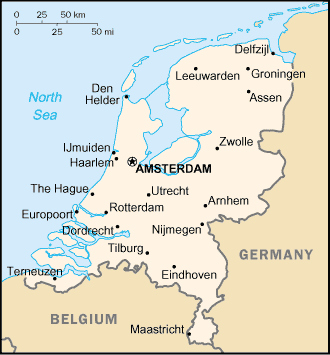
The Netherlands are squished between Belgium and Germany, and have no mountain ranges, thus no natural borders.  This has left them open to invaders for much of their history.  They have been occupied by the Romans, Celts, Vikings, the Austrians (Hapsburg Dynasty), and the Spanish.  One of the most famous wars in their history was against the Spanish called The Eighty Years War, from the late 1500s until they finally gained their independence in 1648.

 
Imagecredit:https://blogger.googleusercontent.com/img/b/R29vZ2xl/AVvXsEicyJPI7GCdyHoVigI3w7Zw2x3Fe_1lfL3mBy_T2mOqo1XheAL-0v5HkcLQf016zjZMxJFqFd6Diw8O8hOiLN0kw_OhRrUOjZzROSEi1sI5jo_ugivsQv_1yv8cHtVchFyg1C1y3nBt1pIe/s1600/80-years-wars.jpg

During the Eighty Years War, the Dutch began large scale overseas trade, becoming dominant in the spice trade with India and Indonesia.  The Dutch started colonies in Brazil, South Africa, the West Indies, and New Amsterdam (New York).  The Dutch became quite wealthy and the period became known as the Golden Age.  At this time each city and province had its own government and own laws, being governed by regents.


Imagecredit:https://www.mayfairgames.com/files/prodimg/pha6026-cl.jpg

In 1808, Napoleon invaded the Netherlands and placed his brother Louis on the throne.  When Napoleon's empire fell, Louis fled, and the country gained its independence from France in 1814.  The Kingdom of the Netherlands was born, incorporating Belgium, Luxembourg, and the Netherlands, but that broke up by the end of the 1800s.  It was at this time that the Netherlands became a monarchy, as it still is today under King Willem-Alexander.

Imagecredit:http://darkroom.baltimoresun.com/wp-content/uploads/2013/04/AFP_Getty-167814490.jpg

The Dutch people remained neutral during WWII until they were occupied by Germany for 5 years.  The Dutch had an extensive Resistance movement against the Nazis.  Many Jewish people had fled to the Netherlands from Germany during Hitler's rise to power in the 1930s, and these were all sent to concentration camps, including Ann Frank and her family.  Of the 140,000 Dutch Jews, only 20,000 survived the war.  The Dutch lost all its colonies in the years following the war.

Imagecredit:http://i181.photobucket.com/albums/x241/Alanp_photo/WWII/NetherlandsLiberationpropaganda.jpg

Before the war, The Dutch used cycle paths for transportation, but they were narrow and not in good condition.  After WWII, the Dutch rebuilt their country and became very wealthy.  By 1950, cities were overrun by cars, and buildings had to be demolished to accommodate them. Cycle paths were removed.  City squares became car parks.  In 1971, 3300 people were killed in traffic accidents, 400 of them being children.  There were mass protests by the people.

Imagecredit:https://s-media-cache-ak0.pinimg.com/736x/16/f4/53/16f45350ce022f79828a92f5fcf7bf74.jpg

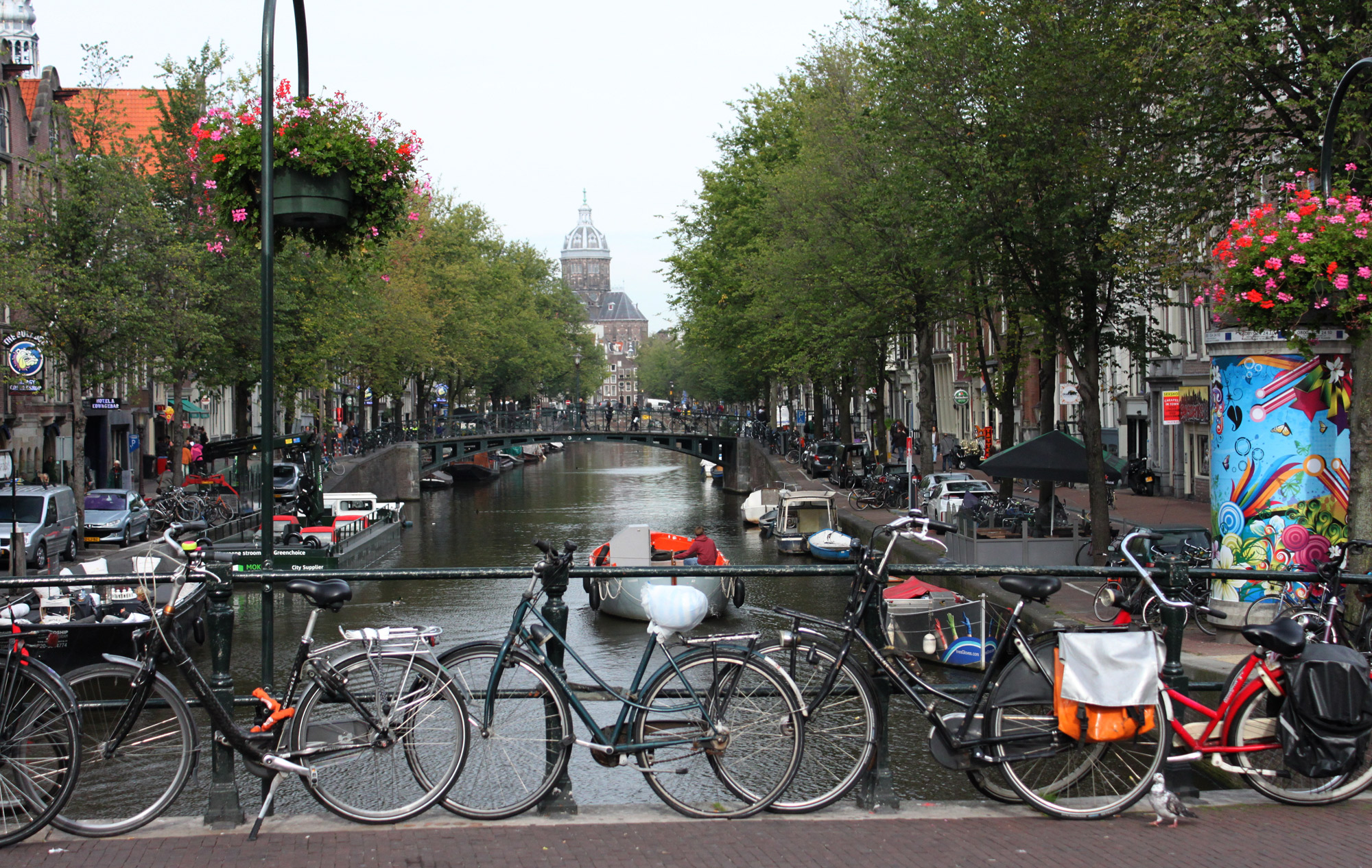
In 1973 the oil crisis meant a shortage of gas and increase of prices, and people were encouraged to change their ways.  An extensive biking system was created.  Child deaths went down to just 14 in recent years.  Today the Netherlands boasts almost 36,000 kms of cycle paths.
Imagecredit:http://www.bikingamsterdam.com/en/blog/wp-content/uploads/amsterdam-canals.jpg

It's amazing that anyone can find their bike in the huge bike parks:

Imagecredit:http://nowastewednesdays.files.wordpress.com/2011/07/amsterdam-bicycles.jpg

Interesting Facts:
- The Dutch are on average the tallest people in the world.
- The Dutch have kept their country from being swept into the sea by building canals, dams, dikes, and pumping stations over the centuries.  Thus the saying:

Imagecredit:http://emmeloord.info/images/tourist/tegelgenerator2.jpg

- The Dutch are amongst the most liberal people in the world with regards to marijuana, homosexuality, and prostitution.
- Famous people include VanGogh, Rembrandt, and Eddie van Halen.

Imagecredit:http://payload301.cargocollective.com/1/16/535601/8324282/van_halen_58.jpg

- The population is 16.5 million people.  The Netherlands is Europe's most densely populated country.
 - The Dutch produce billions of tulip bulbs a year.

Imagecredit:http://kids.nationalgeographic.com/content/dam/kids/photos/Countries/H-P/netherlands-tulip-fields.jpg.adapt.945.1.jpg





Friday, August 19, 2016

Brugge, Belgium


Friday, August 19, 2016

Today we are in Flanders, not the field but the northern area of Belgium that is Dutch speaking.

We docked in Zeebrugge which is of little consequence except for the fact that it is 15 kms from Brugge (known as Bruges in English), where we wanted to go.  Of course, the ship would take you there for $25 each (OUCH!), but through Cruise Critic, we found other people to share a taxi with which was alot cheaper. Ron and Nancy organized it and all we had to do was sign up.  Morven and Uwe signed up too which was funny because we can't stop running into them.   A "taxi" is a van that fits 8 people, and is 100 return. Making the total for each of us only 12.50 return. Which left lots more money for Belgian chocolate, yum.


Once we got into Brugge, we just walked around on our own for the day, which was nice. 


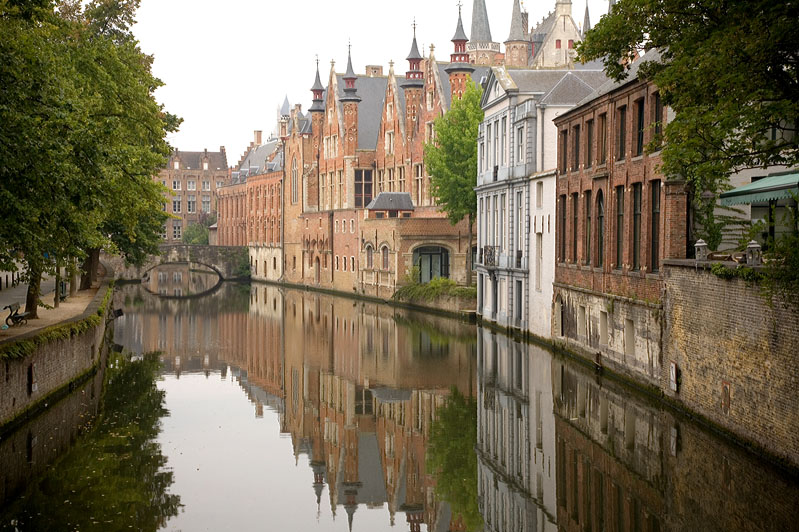
Brugge was established by the Romans and was quite an influential trading port during medieval times (it still smelled like it!), but now it is mostly a leading tourist attraction.  It has tons of canals and bridges, and the name probably comes from the word "bridge".  Brugge has been called the Venice of the North.  Aren't they all?

 
Imagecredit:http://transfers2airports.com/ckfinder/userfiles/images/bruges-canals-01.jpg

The lakes and canals are full of swans.  Apparently in 1488, the city was cursed to have swans forever.  They may have been hated then, but now they are considered a symbol of Brugge.


The Church of Our Lady was started in 1220 and took two centuries to complete.  It has a brick spire which is the 2nd tallest brickwork tower in the world at over 400 ft.

 
imagecredit:https://upload.wikimedia.org/wikipedia/commons/thumb/7/78/Church_Of_Our_Lady_Bruges.jpg/220px-Church_Of_Our_Lady_Bruges.jpg

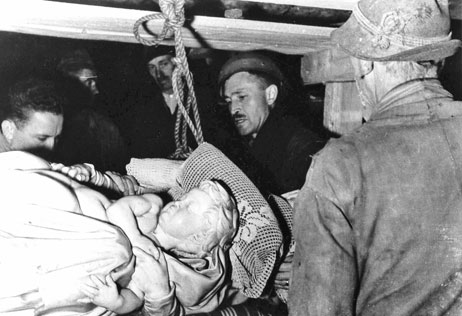
The church contains the sculpture Madonna and Child (1504), which is believed to be the only Michelangelo piece that left Italy during his lifetime.  The statue was stolen by the Germans during WWII but recovered  by the Monuments Men.  This is the statue being recovered from a salt mine in Austria:

By Bundesdenkmalamt Wien - http://www.art-magazin.de/szene/66871/mission_michelangelo_bookmarks?cp=2, Public Domain, https://commons.wikimedia.org/w/index.php?curid=32126139

The church also contains the tombs of Charles the Bold (died 1477) next to his daughter Mary of Burgandy (1482), who died at age 25 when she fell off her horse.


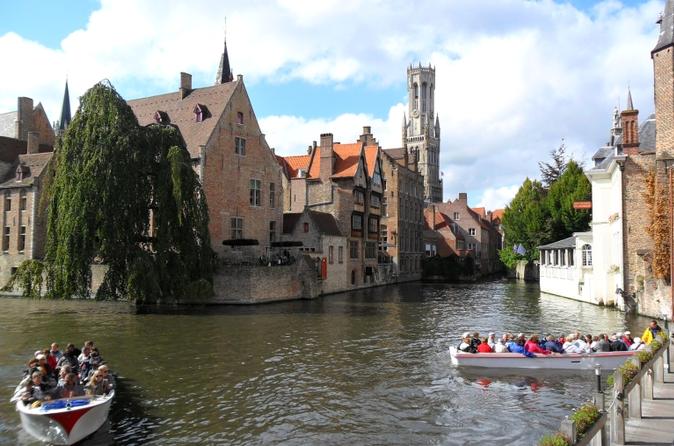
We took a canal trip for 30 minutes.  Rozenhoedkaai is a very famous area for photographs.


St Salvator's Cathedral was built in the 10th century.  The artwork in this cathedral is spectacular.  There are wall carpets from 1731; murals from the 1200s; medieval tombs; and a podium from the 1500s.  The whole place was undergoing renovations.

 
Imagecredit:http://gb.fotolibra.com/images/previews/1230935-gilded-altar-piece-in-the-the-sint-salvator-cathedral-saint-saviour-is-the-main-church-of-the-ci.jpeg

During the day we had to stop at a few chocolate shops, of course. Not hard to do when every second shop is chocolates.  This one got Anton's attention:


But we bought most of our chocolate at Dumon, PLUS they had a bathroom you could use.


We had lunch at the central market square, called the Markt, which has an area of a hectare.


It is surrounded by beautiful, ornate medieval buildings that have now been turned into cafes and restaurants.  Anton had a Belgian waffle and Frankie had Belgian fries. They tasted exactly the same as any other fries except they came with a side of mayo instead of ketchup.  The mayo was good, though.


The toilets here had a mind of their own.  You waved your hand over it to flush it, then an arm came out of the back of the toilet to dribble water into the bowl while the seat LITERALLY did 2 circles around. Weird.

The Markt contains the Belfort (Belfry), built 1240.  This building used to be the city treasury and lookout post.  There are 366 steps in the bell tower that you can climb for a view of the city.  The tower has a slight lean to it.  Anton looked into climbing it, but he said that for 10 euros, they had better carry him up.


The Stadhuis (Town Hall) was built in 1375 and has been the seat of local government for over 600 years.  Inside, it was €4 to see the ornate Gothic Hall.


Next to the Stadhuis is The Basilica of the Holy Blood, which was built in the 1100s to be the chapel for the residence of the Count of Flanders.  It contains a holy relic which claims to be the blood of Jesus collected by Joseph of Arimathea. The vial has never been opened.  Every year on Ascension Day, the vial is paraded through the streets of Brugge.

 
Imagecredit:http://www.thecatholictravelguide.com/BrugesKnight__holy_blood_3.jpg

We entered the Basilica expecting to see the relic behind glass somewhere, but ended up being part of a "Veneration Ceremony".  It was one lady's job just to shush people, while the priest presented the vial to us.  We could all go up to the altar and put our hands over the vial of blood to pray.  The priest said we could leave a donation if we wished.  While we were talking about how much to donate, we got shushed by the lady.  Frankie commented on that to Anton, and we got shushed again.  I guess she takes her job pretty seriously.  These people REALLY believe that this is the real blood of Jesus.


We met our group back at the Markt to catch the 2:30 taxi back to the ship.

Most evenings we have had dinner next to Marge and Ken and enjoyed being spoiled by Ernan and Lucia.


We went to (most of) the show which was a mentalist tonight.  We were curious.  He claimed to be some sort of mind-reader, but he was slow and boring.  Maybe he lacked presentation?

We are packed, ready to get off the ship bright and early tomorrow morning, and ready to spend 3 days in Amsterdam.


Thursday, August 18, 2016

At Sea


Saturday, August 18, 2016

A lazy day at sea, we needed this!


Apparently the ship stopped in the middle of the ocean for two and a half hours last night, someone had to be medically evacuated by helicopter.  We slept through it all.

Captain Dimitrios gave an interesting talk this morning (running on 3 hours of sleep and lots of caffeine) on the ship's navigational systems.  There are 8 different ways to steer the ship if the main wheel breaks down.  If all else fails, the portholes on deck 2 are retractable and there are oars under each bed, ha ha.  He is quite a jokester.


There was a Q&A session. Some interesting facts:
- This ship won the Environmental Ship of the Year award.
- Every year the captain needs to get a certification stating that he is "sane".
- There are 2 jail cells on the ship, and every cabin can become a jail cell.  When there are unruly passengers, they are locked in their cabins and dropped off in port the next day.
- The ship gets about one foot per gallon of gas.  So much for being environmental.
-  Modern day cruise ships make the Titanic look like a tug boat.  Here they are side by side:


Other facts we have dug up that were not mentioned:
- Cruise ships have morgues with refrigeration units.  Every year 200 people die on cruise ships.
- When you see "Friends of Bill W" on the daily program, it refers to Alcoholics Anonymous meetings.
- Some people actual retire and live full-time on cruise ships, finding it cheaper than retirement homes.

There was a lunch organized today for all of us who had signed up for the Cruise Critic Roll Call.  We took up one whole side of the dining room. We sat with our Scottish friends Morven and Uwe (rhymes with groovy).


Duck l'orange for dinner.  I think they gave Frankie the whole duck:


We actually went to the show tonight.  We have gone to surprisingly few of the shows this time.

Wednesday, August 17, 2016

Edinburgh Day 2

Wednesday, August 17, 2016

Another absolutely gorgeous day in Scotland.  The locals can't believe it.

We found out that the last tender was at 2:30 am, glad we made it in early!

Another day to explore Edinburgh!  Since we had not been inside the Edinburgh Castle yet, we started there in hopes of beating some of the crowds.  Just to make sure, we bought advance tickets.  Edinburgh Castle is situated high on a rock, actually on an extinct volcano. 

Imagecredit:https://media-cdn.tripadvisor.com/media/photo-s/06/99/dd/7b/princes-street-gardens.jpg

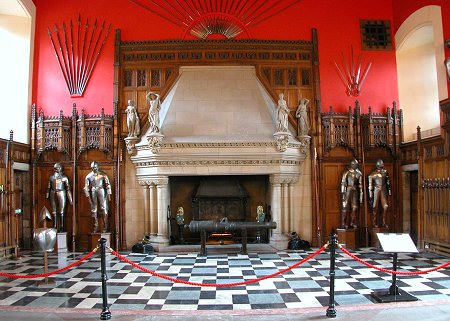
Humans have lived on the rock since the 2nd century.  David I built the present castle in 1130.  In 1566, Mary Queen of Scots gave birth here to her son who later became King James VI of Scotland and King James I of England.  The "birthing room" was about the size of our bathroom back home.  Here is the Great Hall:

 
Imagecredit:http://www.undiscoveredscotland.co.uk/edinburgh/edinburghcastle/images/upper-fireplace-450.jpg

The castle was a royal residence until the early 1600s. Research shows that over its 1100 year history, the castle saw 26 sieges, making it the most attacked place in Great Britain. The castle last saw military action in 1745.  After that it was a prison from 1757 until 1814 (when 49 prisoners of war escaped!) and an army base until the 1920s.  It was also a prison during both World Wars.


Mons Meg is a siege cannon from 1449.  It was fired in 1558 to celebrate the wedding of Mary Queen of Scots, and the 150 kg cannon ball was found over 3 kilometers away.  It was last fired in 1681 on the Duke of Albany's birthday, and the barrel burst open.


In 1650, Oliver Cromwell besieged the castle.  The Honours of Scotland (Crown, Sword, and Sceptre) were buried at a distant church so that Cromwell could not get his hands on them. Sir Walter Scott rediscovered them in 1818.  They were hidden again during WWII in case of German occupation.  You can now see the Honours of Scotland in the Crown Room:


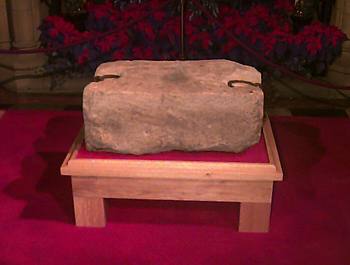
We also saw the Stone of Scone, or the Stone of Destiny.  This is a rock of yellow sandstone that weighs 336 lbs.  It was used to crown Scottish kings until Edward I invaded Scotland and took the stone to London.  It became part of the Coronation Chair at Westminster Abbey, to symbolize the rule of English kings over Scotland.

Imagecredit:http://www.educationscotland.gov.uk/Images/CoronationChair%20and%20StoneofDestiny%20L_tcm4-562048.jpg

There was supposedly a metal plate attached to the stone, with an inscription that read:

Unless the fates be faulty grown
And prophet’s voice be vain
Where’er is found this sacred stone
The Scottish race shall reign.

This legend was fulfilled when King James became both King of Scotland and King of England.  The stone was last used in 1953 for the coronation of Queen Elizabeth II.  In 1996, the stone was returned to Scotland by the British government.


The castle was absolutely packed and we're glad we went early.  When we left, the line must have been an hour long for tickets.


We found a curbside just below the castle, on the Royal Mile, and snacked on some food we had brought, while listening to a busker piper.  Where else in the world could you do that?


We walked all the way down the Royal Mile, which was full of buskers.  In the space of 2 minutes, we saw a mermaid, Minnie Mouse, Darth Vader, and Harry Potter. Quite fun.


We eventually got down to the Holyroodhouse Palace, built in the 1500s.  This has been the official Royal Residence since the 16th century.  It is open to tourists whenever the Royal family is not staying here.  Our ticket came with a free audio tour that explained everything room by room:


This is where Mary Queen of Scots lived until she fled to England hoping to receive protection from Queen Elizabeth I.  Mary married both of her Scottish husbands here, Lord Darnley and James Hepburn (Bothwell).

 Imagecredit:http://www.everycastle.com/images/Holyrood%20Palace%201.jpg

It was here in 1566 that Mary's jealous husband Darnley used the private stairs to enter the queen's apartments, grab her secretary David Rizzio, and stab him 56 times.

 
Imagecredit:http://madameguillotine.org.uk/wp-content/uploads/2012/11/QueenMaryBedroom.jpeg

To celebrate Queen Elizabeth's 90th birthday, there is an exhibition on her wardrobe.

 
 Imagecredit:http://i.telegraph.co.uk/multimedia/archive/03567/Queen_Elizabeth_II_3567793k.jpg 

We had a peaceful walk through the Holyrood Palace Gardens:


We grabbed a taxi to the Edinburgh Botanic Gardens, established in 1670.  It is over 70 acres large and has over 15,000 plants.  It was free except for the greenhouses. The 10 greenhouses were all connected and very nice to walk through, although Anton complained about the humidity.


We decided to call it a day around 4 pm, we were both tired, and we wanted to eat on the ship where Ernan and Lucia take such excellent care of us.  By the time we got a taxi to the dock and then were tendered in, it was 5 pm.